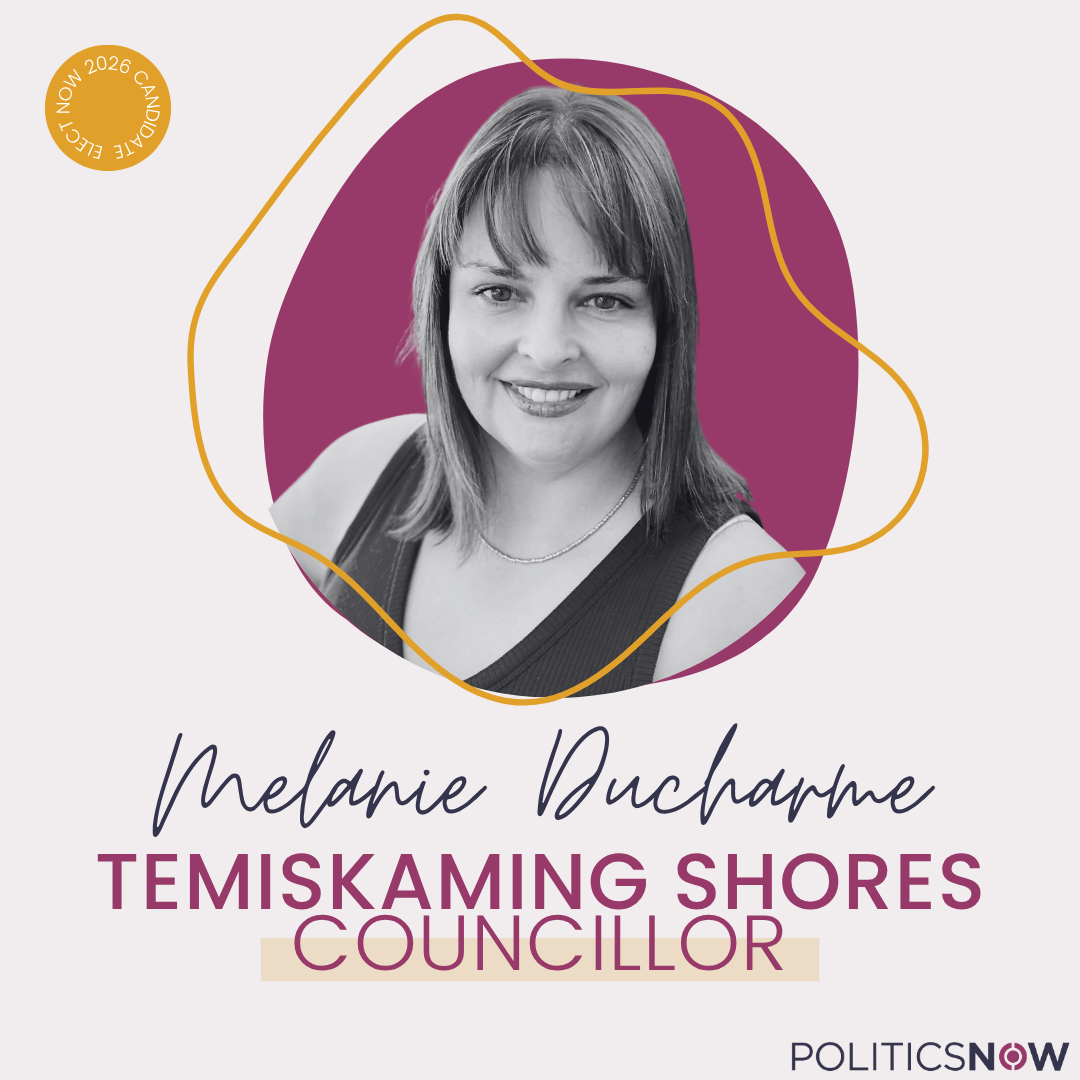
Melanie Ducharme
Melanie Ducharme is running for Councillor in Temiskaming Shores.
Melanie Ducharme (she/her/elle) grew up in Temiskaming Shores, where she now lives with her husband, their teenager, and her mother. She holds a master's degree in business and has worked across the arts, manufacturing, and legal services sectors. Melanie currently leads a nonprofit organization providing shelter and support to survivors of violence and developing affordable housing, including safe housing for women and children leaving violence. She is completing her first term on Temiskaming Shores City Council, during which she has worked on municipal infrastructure, transit funding, and strategic planning. She also serves on the Temiskaming Shores Public Library Board, Committee of Adjustment, and Transit Committee, and organizes the local Take Back the Night event. Outside her professional and community commitments, Melanie enjoys backcountry canoeing, music, and writing her newsletter, Portage.
Why are you running for this position?
I ran for city council four years ago because I wanted to see more diverse voices, and in particular women's voices, at the table and a brighter future for the kids growing up here — a city where everyone can belong. That work is underway: we’ve secured major funding for our water and sewer infrastructure, turned a day-one transit crisis into one of the largest transit grants this municipality has ever received, and delivered a strategic plan built with real resident input, all while increasing our reserves and reducing our debt. I’m running again because there’s more to do — on housing, on protecting our lake, on safer streets, and on supporting the volunteers who hold this community together. I want to see this work through.
What do you love most about your community?
I love how our community operates way above its size and paygrade because of all the work of volunteers!
What do you think is the biggest challenge facing your municipality right now?
I think the biggest challenge facing the municipality is the need for housing - and the infrastructure gap that makes it hard to build that housing.
If elected, what is one thing you would like to accomplish during your term?
I would like to see us moving the needle on housing with a variety of creative and community-focused projects.
What is one thing you would like to see your municipality do differently?
I'd like to see us change how we look at housing and start to look at the issue as multi-layered. I’d like to see us do a real housing study — a clear-eyed look at what kind of housing we actually have versus what our residents need, so we know precisely where the gaps are. Then I want us to take that information to developers and make the case: here’s what’s missing, and here’s why this is a good place to invest. And I want to build the local expertise, relationships, and knowledge to support a full range of housing types — not just one kind — because affordable housing, supportive housing, housing for young families, and housing for seniors are all different problems that need different solutions, and right now we’re not set up to tackle all of them well.
What does good local government look like to you?
To me, good local government starts with having a table that actually reflects the community — different voices, different experiences, different reasons for being there — because the decisions land differently depending on who’s making them. From there, it’s council doing the job council is actually for: setting clear direction and priorities, then trusting the people with real expertise to carry out the work, rather than second-guessing every decision from the council table. It means being straight with people about what we control and what we don’t — a lot of the biggest costs in a municipal budget are decided somewhere else — so the real test is how disciplined and smart we are with the parts that are actually ours: water, roads, lights, the services people depend on daily. And it means building plans with real resident input instead of for show, then sticking with them long enough to actually see them through, term after term.
If you received a $1 million grant to use for your municipality any way you wanted, what would you do with it?
I’d use it to leverage funding to bring the Bun Eckensviller Community Hall up to accessibility standards and turn it into the true multi-use space it should be — a home for our volunteer arts organizations and the Legion. Right now the building’s condition is a real problem, and every year we wait, it gets harder and more expensive to fix. A million dollars put toward accessibility and renovation could be exactly the piece that unlocks the rest of the funding needed to finally give those groups a space that works for them.
How do you approach working with people who disagree with you?
I try to start from the assumption that someone who disagrees with me usually has a piece of information or a lived experience I don’t have, so my first move is to get curious about that rather than defend my position. On council, that means I can vote against someone’s request, after weighing the information honestly, and still sit down with them afterward and keep working together — the decision and the relationship are two different things. And when a disagreement is really about values — like how our community talks about newcomers, or where growth should happen — I’d rather name it directly and have the harder conversation than pretend we agree, because papering over it doesn’t actually solve anything. I will probably do a lot of research behind the scenes!
What does having more women in local leadership change?
Women notice different things, because we live different things — the cost of childcare, a transit schedule that doesn’t line up with a work shift, how safe a street feels when you’re walking it with a stroller or after dark. Having more women at the table means those realities actually make it into the conversation before a decision gets made, instead of as an afterthought once something’s already gone wrong. It tends to change how decisions get made, too, not just what gets decided — a push toward real resident input and less top-down process often comes from the people who’ve had decisions made about them their whole lives. And representation matters on its own terms: when a girl growing up here sees women leading, it changes what she thinks is possible for herself. I ran the first time because I wanted more diverse voices — including women and moms — at the table, and that’s still exactly why I’m running now.
What is something about you that you would like voters to know that they might not learn from your campaign platform?
Balancing work, family, and council is harder than people probably realize. I went to a business opening recently — I don’t get to many of these because my day job keeps me busy, but I’d had to cover a night shift, which gave me a rare day off. Someone made a comment about how it must be election season, implying that’s the only reason I’d shown up. I didn’t take the bait, but it stuck with me, because people don’t always see how much I’m trying to put my best face forward across every part of my life at once — council, work, my community, and my family. When I really need to unplug, I’m usually a few days into a backcountry canoe trip with no cell signal, writing or playing music at home — that’s where I actually get to just be one person again instead of four.
Where can people find you?
Facebook: @vote4melanieducharme
Instagram: @vote4.melanie.ducharme
Learn about the other women running in the 2026 Ontario Municipal Election.