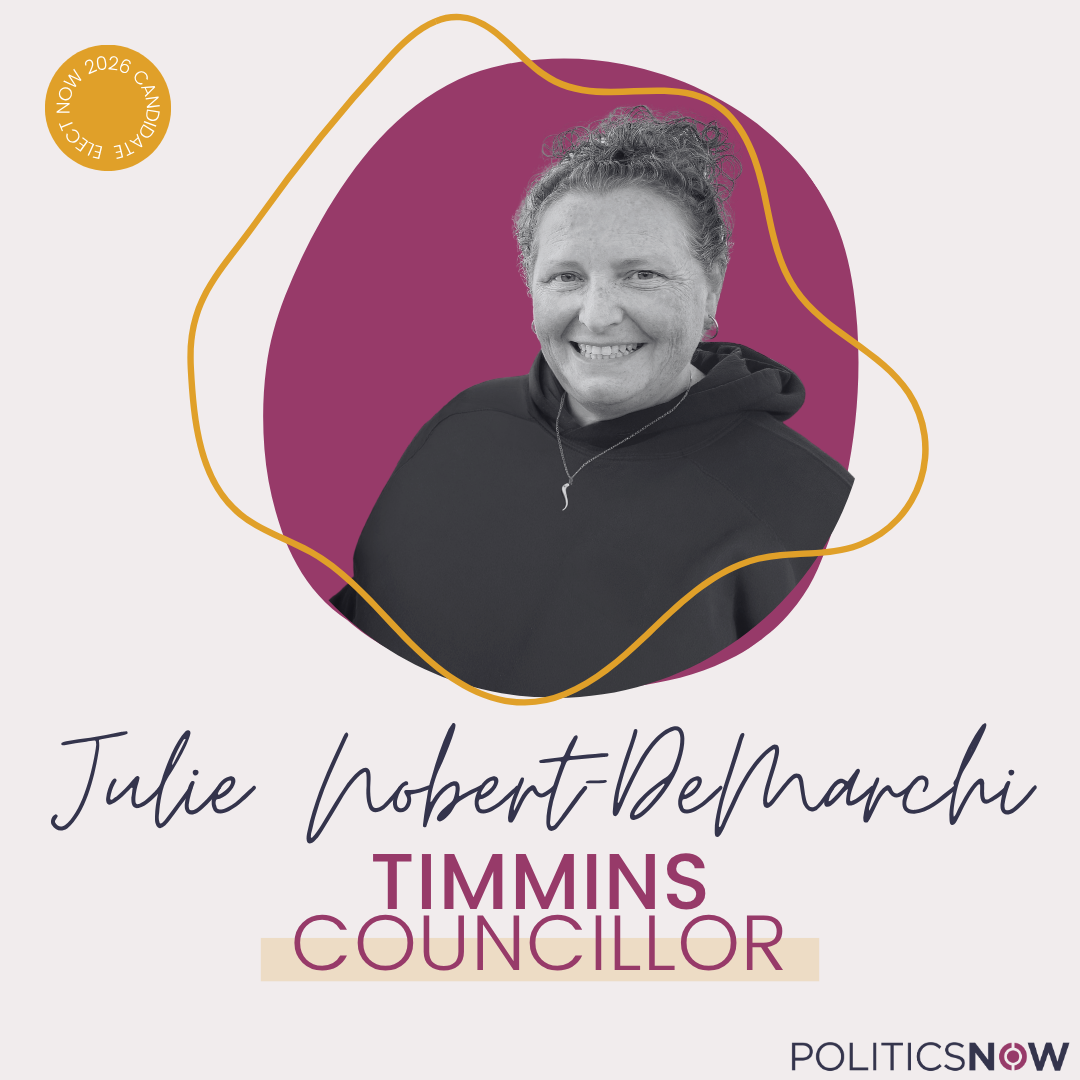
Julie Nobert-DeMarchi
Julie Nobert-DeMarchi is running for Councillor in Ward 5 in Timmins.
Julie Nobert-DeMarchi (she/her/elle) grew up in Timmins, where she has raised her family, built her career, and dedicated much of her life to community service and advocacy. She brings more than 25 years of nonprofit leadership experience, including serving as Executive Director of Timmins and Area Women in Crisis since 2010, following roles with the Heart and Stroke Foundation and the Venture Centre. Her professional background includes financial management, governance, strategic planning, human resources, program development, and government relations. Julie is actively involved in initiatives addressing homelessness, community safety, and human trafficking, including co-chairing the Regional Anti-Human Trafficking Committee. A longtime volunteer, she is also a founder and current Vice-President of Fierté Timmins Pride and a former President of Fierté Canada Pride. Julie is a partner, mother of three, grandmother of four, and former foster parent whose experiences have shaped her commitment to equity, inclusion, and community belonging.
Why are you running for this position?
I'm running for Timmins City Council because I care deeply about our community and believe my experience, knowledge and established relationships would allow me to contribute meaningfully from day one.
I've spent much of my life working alongside residents, community organizations, businesses and different levels of government. Through my involvement with the Homelessness Response Partner Group, the System of Care Community Advisory Board, the Community Safety and Well-Being Leadership Committee, and other collaborative initiatives, I've gained a firsthand understanding of the challenges we're facing and the work already underway to address them.
Timmins faces difficult decisions around housing, homelessness, community safety, infrastructure and economic development. We also have tremendous opportunities, particularly with continued investment in mining. I want to help ensure that our decisions are thoughtful, financially responsible and focused on lasting benefits for our community.
I'm also passionate about seeing more women and a greater diversity of experiences and perspectives represented around the Council table. Throughout my life, I've advocated for equity, inclusion and opportunities for those whose voices haven't always been heard.
I'm not running because I believe I have all the answers. I'm running because I have experience to contribute, relationships to build on and a genuine commitment to doing the work.
For me, leadership means listening, asking difficult questions, understanding the evidence and being accountable for the decisions we make. It also means having the courage to challenge ideas when necessary, while treating others with kindness and mutual respect.
What do you love most about your community?
What I love most about Timmins is that it's home. And when I say home, I mean so much more than the place where I live.
I grew up here, went to school here, raised my three children here and built a life filled with family, friendships and meaningful connections. Now, as a grandmother of four, I appreciate even more the importance of having a community where families can grow and feel connected.
I've been volunteering since I was a teenager, and over the years, I've had the privilege of working alongside so many dedicated people who give their time and energy to making Timmins a better place. That willingness to show up for one another is something I've always valued.
I also love our diversity. Our Indigenous, Francophone and 2SLGBTQIA+ communities, along with the many cultures, backgrounds and experiences that make up Timmins, contribute to its character and strength. And there's something special about living in Northern Ontario, surrounded by nature, with the outdoors right at our doorstep.
I've celebrated our successes, witnessed our struggles and worked alongside others to make our community stronger. Timmins isn't perfect, and I don't need it to be to love it.
It's part of who I am, and I want everyone who calls Timmins home to experience that same sense of belonging, connection and opportunity.
What do you think is the biggest challenge facing your municipality right now?
I believe one of Timmins' biggest challenges is addressing housing, homelessness and community safety while ensuring we're planning responsibly for our future.
These issues are interconnected, but they're not interchangeable, and there isn't one solution that will address them all. Residents and businesses have legitimate concerns about safety and quality of life, while those experiencing homelessness need access to appropriate housing, services and supports. Both realities deserve our attention.
Through my involvement in community partnerships, I've seen the work being done to identify gaps and develop solutions. Often, the greatest barriers are insufficient resources, limited service capacity and the need for sustained provincial and federal investment.
At the same time, Timmins has significant opportunities for economic growth, particularly in mining. But growth needs to be about more than attracting investment. It's about creating the conditions for people to build their lives here, including attainable housing, good jobs, thriving local businesses, recreation, arts and culture, and the infrastructure and services our community needs.
For me, a strong economy and a strong social fabric go hand in hand. Council needs to respond to today's challenges while making thoughtful decisions that strengthen our community over the long term.
If elected, what is one thing you would like to accomplish during your term?
I'd like to help Timmins make measurable progress on our most pressing challenges while contributing to a more cohesive and effective City Council.
We have dedicated community organizations, service providers and partners already working on issues such as housing, homelessness and community safety. I'd like to see Council build on that work by strengthening partnerships, identifying realistic priorities and advocating for the resources needed to turn plans into results.
But I also believe how Council works together matters.
I'd like to contribute to a Council where different perspectives lead to productive conversations rather than ongoing division. That doesn't mean agreeing on everything. Healthy debate and difficult questions are essential to good governance. What matters is our ability to work through disagreements respectfully, consider the evidence and established best practices, and find a way forward.
I recognize that one councillor can't solve these challenges or change Council's dynamics alone. But each councillor can contribute to an environment where decisions are informed, constructive and focused on the community.
By the end of my term, I'd like to see tangible progress on important local issues and a Council that demonstrates we can disagree, make decisions and still work together to deliver results.
What is one thing you would like to see your municipality do differently?
I'd like to see Timmins take a more proactive and coordinated approach to long-term planning, with greater opportunities for residents to be involved before major decisions are made.
Housing, community safety, infrastructure, economic development and quality of life are all connected. We need to consider how decisions in one area affect others, rather than looking at each issue in isolation.
I'd also like to see community engagement happen earlier and more meaningfully. Residents should have opportunities to understand what's being considered, share their perspectives and see how their input influences decisions.
Good planning also means understanding what falls within the City's responsibilities, where collaboration with community partners is needed, and when we must advocate for action and investment from provincial and federal governments.
And once decisions are made, we need clear priorities, realistic timelines and regular updates on progress, including what's working and where adjustments are needed.
I recognize the City already undertakes planning and consultation. I'd like to build on those efforts and strengthen how they're connected.
For me, it's about being more intentional about where we want Timmins to be in five, ten or twenty years, and making sure today's decisions help us get there.
What does good local government look like to you?
To me, good local government listens to residents, makes informed and responsible decisions, works collaboratively and is accountable for the results.
It starts with understanding the issues, asking difficult questions, examining the evidence and considering different perspectives, particularly those of people directly affected by a decision.
It also requires a Council that can work together. We don't need to agree on everything, but we do need to approach disagreements with kindness and mutual respect, remain open to new information and find constructive ways forward. Collaboration doesn't mean automatically agreeing with everyone around the table. It means being willing to question, challenge and work toward informed decisions.
Fiscal responsibility is equally important. Residents deserve to know their tax dollars are being managed wisely. But responsible financial decisions require us to consider not only what something costs today, but also what it may cost our community if we fail to address a problem.
I also believe transparency and accountability go hand in hand. Residents should understand why decisions are made, have meaningful opportunities to participate and know whether the intended results are being achieved.
Good government isn't about having all the answers. It's about being willing to listen, do the work, make difficult decisions, follow through and remain accountable to the community.
If you received a $1 million grant to use for your municipality any way you wanted, what would you do with it?
I'd prioritize using that $1 million to help move forward a practical housing initiative that addresses homelessness and housing instability in Timmins.
We know that access to appropriate housing is a significant challenge, and that housing stability is closely connected to health, community safety and quality of life.
Rather than creating an entirely new initiative, I'd want to look at projects and solutions already being developed by community partners and identify where this investment could remove a significant barrier or help bring something to fruition.
I'd also explore how we could leverage the funding to attract additional provincial, federal or private-sector investment, allowing that initial $1 million to have a greater impact.
Sustainability would be an important consideration. I wouldn't want to create a program or facility without understanding the ongoing operating costs and how those would be supported.
There are many worthwhile priorities in Timmins, but I'd want this investment to address a pressing need while creating lasting benefits.
For me, the goal wouldn't simply be to spend $1 million. It would be to make sure that investment leads to meaningful, measurable improvements in our community.
How do you approach working with people who disagree with you?
I believe we can disagree without being disrespectful, and that some of the most productive conversations happen when we're willing to listen to perspectives that challenge our own.
My approach is to start by assuming good intentions and trying to understand where the other person is coming from. I believe most people who get involved in their community genuinely want to make things better, even when they have very different ideas about how to accomplish that.
That doesn't mean I automatically agree or avoid challenging a position. I'm comfortable asking difficult questions, expressing concerns and standing firm on issues that matter to me. But I also recognize that I don't have all the answers, and I'm willing to reconsider my perspective when presented with new information.
Throughout my career and volunteer work, I've worked with people from different backgrounds and organizations on complex issues where there isn't always an easy solution. I've learned that finding common ground doesn't have to mean compromising your principles.
I also think it's important to separate the person from the issue. We can challenge ideas and hold one another accountable without making things personal. Assuming good intentions doesn't mean overlooking harmful behaviour or avoiding accountability.
I don't need everyone to agree with me, and I don't expect to agree with everyone. But I believe we owe each other the respect of listening, the willingness to learn and a genuine commitment to working together.
What does having more women in local leadership change?
I believe having more women in local leadership broadens the experiences and perspectives represented when decisions are being made, helping create a Council that better reflects the community it serves.
Women bring different backgrounds, knowledge and leadership styles to the table. There isn't one way that women lead, and I wouldn't suggest that women automatically make better decisions simply because they're women. But when decision-making spaces lack diversity, important experiences and perspectives can be overlooked.
Throughout my career, I've advocated for opportunities for women and others who have historically faced barriers to leadership. I've seen how policies and decisions can affect people differently depending on their circumstances, and why understanding those differences matters.
Representation also matters for future generations. When girls and young women see themselves reflected in leadership positions, they can see those opportunities as possibilities for themselves.
And women aren't one homogeneous group. Our community includes Indigenous women, Francophone women, racialized women, women with disabilities, 2SLGBTQIA+ individuals and people with many different lived experiences.
For me, it's not about replacing one perspective with another. It's about ensuring more voices are part of the conversation and that our decisions reflect a fuller understanding of the community we serve.
What is something about you that you would like voters to know that they might not learn from your campaign platform?
Beyond my professional experience and community involvement, family is a huge part of who I am.
I'm a partner, mother of three, grandmother of four, former foster parent and dog mom. Those roles have brought me some of life's greatest joys, along with plenty of challenges and lessons along the way.
Like many families, we've navigated busy schedules, unexpected changes and the everyday realities of balancing responsibilities. Those experiences have taught me patience, compassion and the importance of being there for one another.
And while much of my work involves serious and sometimes difficult issues, I also value humour, laughter and finding joy in everyday moments. I love spending time with family and friends, building relationships and connecting with people.
I don't always get everything right, and I don't pretend to. I'm someone who continues to learn, values kindness and believes that how we treat one another matters.
At the end of the day, beyond the titles and responsibilities, I'm simply someone who cares deeply about family, community and the people around me.
Where can people find you?
Facebook: https://www.facebook.com/connectwithjulie
Instagram: https://www.instagram.com/connectwithjulie/
Wesbite: connectwithjulie.ca
Learn about the other women running in the 2026 Ontario Municipal Election.