
Planning Your Campaign By Phase

The best way to plan a campaign is to start with Election Day and work backwards.
Campaigns can feel overwhelming because there is always something to do. Recruit volunteers. Raise money. Knock on doors. Write your website. Figure out your signs. Attend community events. Post on social media. Answer emails. Develop your platform. Talk to voters. And somehow remember to eat lunch.
The trick is that you don't need to do everything at once.
A campaign has different phases, and each phase has a different job. Once you know where you are in the campaign, you can figure out what deserves your attention right now — and, just as importantly, what can wait.
We recommend starting with Election Day and working backwards. That gives you a deadline to plan around and lets you turn a giant, intimidating campaign into a series of smaller pieces.
So, What Phase of the Campaign Are You In?
Every campaign is a little different, but most campaigns move through roughly six phases: consideration, exploration, announcement, campaign, Election Day, and post-election.
Think of these as guideposts rather than perfectly sealed boxes. You may move between phases, overlap them, or spend much longer in one than another. That's completely normal.
Consideration.
This is you if: you're thinking about running for office, but you haven't decided whether you're actually going to do it. This is the time to be curious. Learn about the position. Understand what the job actually involves. Talk to people who know your community. Think honestly about your motivations, your capacity, your family and work commitments, and the things that might make running difficult. You don't need a campaign team yet. You don't need a logo. You definitely don't need 5,000 campaign buttons.You need to figure out whether running is something you genuinely want to pursue.
Exploration.
This is you if: you've moved from “Maybe I should run” to “Okay, I'm seriously considering this.” Now it's time to start laying the groundwork. Talk to people beyond your immediate circle. Connect with community leaders, colleagues, potential supporters, people who understand local politics, and — perhaps most importantly — people who will give you an honest answer rather than simply telling you that you're wonderful. Start learning about the community you'll be asking to represent. Begin identifying potential volunteers and supporters. Think about what your campaign might need, what you want to stand for, and what kind of team you would want around you. This is also when your campaign begins to become real, even if you haven't announced anything publicly.
Announcement.
This is you if: you've made the decision and you're officially running. Your priorities start to shift. You need to introduce yourself to a much larger audience and make it clear who you are, why you're running, and what you hope to accomplish. Your announcement is not the entire campaign. It's the beginning of the public campaign. From here, your communications, fundraising, volunteer recruitment, voter outreach, and campaign planning all start working together.
Campaign.
This is you if: you're in full campaign mode. This is the part most people picture when they hear the word campaign: knocking on doors, attending events, identifying voters, recruiting and managing volunteers, fundraising, communicating with voters, sharing your ideas, responding to issues, and generally discovering that there are approximately 47 things you thought would take five minutes. The campaign phase is where your earlier planning pays off. You should have a clear sense of your goals, your key audiences, your campaign team, your budget, and how you're going to reach voters. Now the job is to execute that plan, pay attention to what's working, and adjust when it isn't.
Election Day
This is you if: it's finally here. By Election Day, your campaign should not be inventing a new strategy. Your focus shifts to Get Out the Vote (GOTV) — making sure the people you've identified as supporters actually have the information and opportunity they need to vote. Where they vote. When they can vote. What identification they need. Whether they have a plan to get there. Whether you've followed up with them. Election Day is about execution. The planning should have happened long before you wake up that morning.
Post-Election
This is you if: the election is over. Whether you won or lost, the campaign isn't quite finished. You'll need to properly wind down your campaign, take care of outstanding bills, complete any required financial reporting, deal with remaining campaign materials and funds, and make sure your records are in order. And then — eventually — you get to breathe. If you won, you'll be moving from campaigning to governing. If you didn't, you'll have an opportunity to reflect on what happened, what you learned, and what comes next.
Now Work Backwards From Election Day
Knowing your phase is useful, but the real magic happens when you start turning that phase into numbers and deadlines.
Start with Election Day and ask: How much time do we have? Then work backwards.
How many voters do you need to identify? How many people do you need to speak with to identify those voters? How are you going to reach them? How many volunteers will you need? How much money will those activities require?
This is where your campaign goals become an actual plan.
🧮 THE MATH
600 supporters ÷ 12 weeks = 50 supporters per week
That's your starting target: about 50 identified supporters a week. If your campaign identifies roughly one supporter for every five meaningful voter conversations, that's about 250 conversations a week — across your whole campaign team.
That could mean five people each having 50 conversations a week, or 10 people each having 25. The point is to break the number down until it feels like something your campaign can actually accomplish.
And remember: these are planning numbers, not universal rules.
A small-town campaign, a rural campaign, and a campaign in a large urban ward will have very different numbers to work with.
Once you have that number, you can start planning by asking yourself:
How many doors does that mean?
How many canvassing shifts?
How many volunteers?
How much money do you need for signs, literature, digital advertising, events, transportation, and everything else required to reach those voters?
Your Strategy Can Change, But Your Goals Should Stay Visible
One of the most useful things about planning by phase is that it helps you decide what not to do.
If you're still in the exploration phase, spending three hours every day creating social media content might not be the best use of your time. You may get much more value from talking to community members and building your team.
If you're in the middle of the campaign and you're not reaching enough voters, it may be time to recruit more volunteers rather than simply posting more often.
If you're getting close to Election Day, your priorities will look different again. You should be increasingly focused on voter contact, identifying supporters, and preparing your GOTV operation.
Your strategy can — and should — change as you learn more. But your overall goals should stay visible so that you're always asking whether the work you're doing is moving you toward them.
Use the Numbers to Make Decisions
This is why we like working backwards from Election Day.
The numbers aren't there to make your campaign feel more complicated. They're there to help you answer practical questions.
If you have 100 days left and need to identify 3,500 supporters, is your current voter-contact plan realistic?
If you need 20 volunteers at every canvass but you're only recruiting five, what needs to change?
If your plan requires more money than you're currently raising, do you need to adjust your fundraising strategy or reconsider how you're spending?
If you're spending most of your time on things that aren't helping you reach voters, what could you stop doing?
A good campaign plan isn't a list of everything you could possibly do. It's a plan for doing the things that matter most, at the time they matter most.
And that's the beauty of planning by phase. You don't have to solve the entire campaign today.
You just need to know where you are, where you're going, and what needs to happen next.
Looking for some extra support?
Grab one of our workbooks!
Our workbooks are your step-by-step approach to help you really dive into the fundamentals of a successful campaign, and are the thing that you absolutely need to help you run for office.


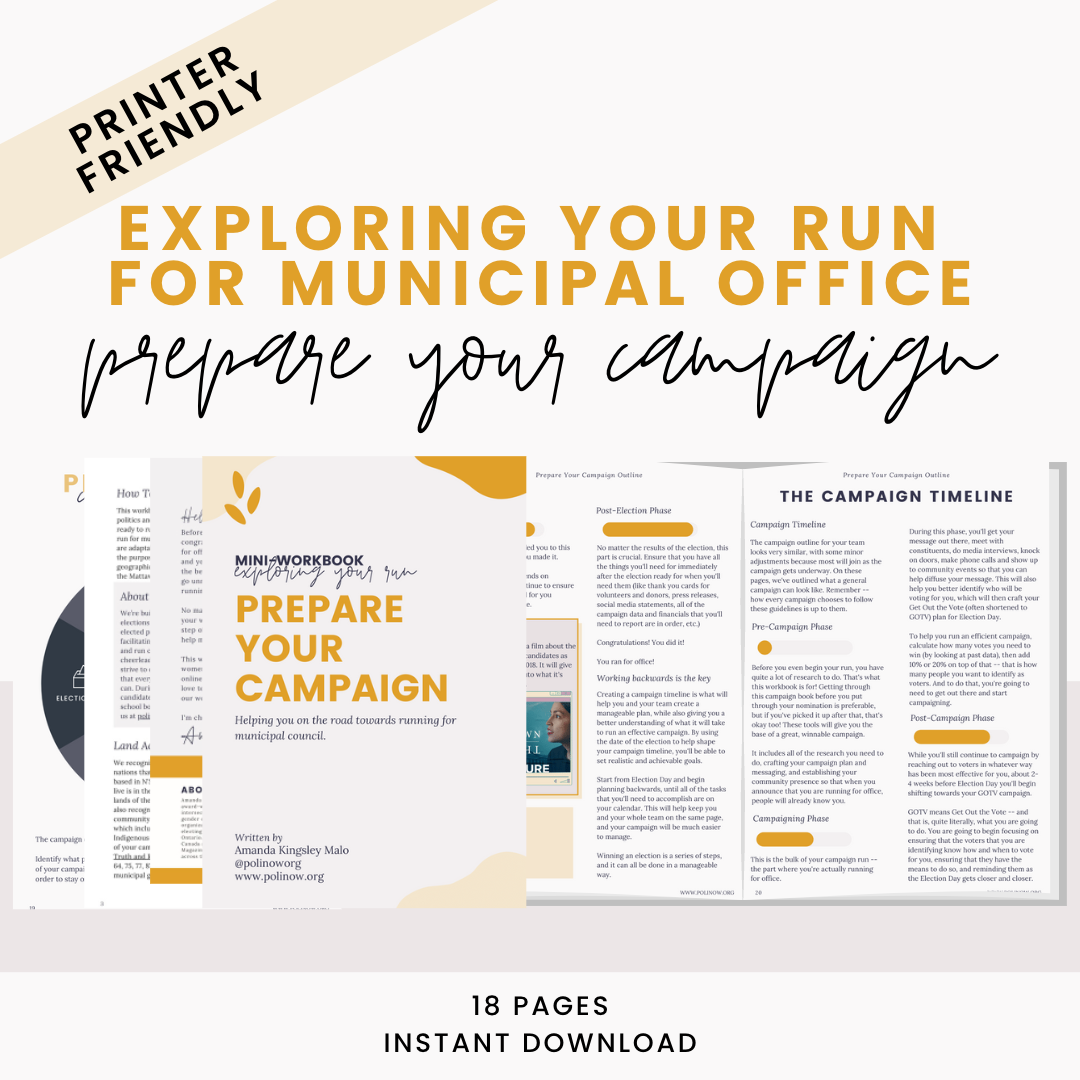

Everything you need to explore your run, make confident decisions, and prepare for a successful campaign — all in one digital workbook.
Running for municipal office is exciting, meaningful, and yes — a little intimidating. That’s why I created this workbook: to help you explore the possibility, ask the right questions, and get organized before making any big commitments.
The 2026 edition is fully updated, with clearer guidance, new resources, and a brand-new chapter on protecting your peace — because running for office is serious work, and you deserve to feel good doing it.
What’s Inside:
Updated Guidance: Refreshed examples, links, and resources relevant to 2026.
New Chapter: Protecting your peace, including a worksheet to help you set healthy boundaries.
Bonus Audio: A reworked workshop in audio format, perfect for listening on the go.
Clear Explanations: Simplified, step-by-step guidance to take the guesswork out of early campaign decisions.
Practical Worksheets: Define your mission, map your community, and build your campaign team.
Why This Workbook Works:
Helps you make a confident decision to run
Breaks down complex campaign steps into simple, actionable exercises
Created by Amanda Kingsley Malo — educator, campaign veteran, and your personal guide through local politics
Format:
30+-page PDF
Instant download
Works on computer, tablet, or phone