

Your campaign needs more than a good candidate and a great message. Here’s how to use the numbers to figure out what you’re actually working toward.
Before you start knocking on doors, raising money, and recruiting volunteers, you need to know what you're actually trying to accomplish.
How many votes do you need to win?
How many voters do you need to identify?
How many doors will you need to knock on to find those voters?
How many volunteers will you need to make that happen?
And, naturally, how much money is all of this going to cost?
Campaigns are, in many ways, a numbers game. That doesn't mean your campaign should become a giant spreadsheet or that you can somehow calculate your way to victory. Elections are won by people, relationships, ideas, and hard work. But the numbers can help you understand what that hard work needs to look like.
One of the biggest mistakes candidates can make is setting goals based on what sounds good rather than what the race actually requires. “We're going to knock on lots of doors!” is a nice sentiment. “We need to make 15,000 voter contacts before Election Day, which means we need three canvass shifts a week and eight volunteers at each shift” is a campaign plan.
So before you get too far into the weeds, let's do a little math.
First, Figure Out Your Win Number
Your win number is your best estimate of how many votes you'll need to win your election.
And yes, we know what you're thinking: How could we possibly know how many votes we're going to need? The election hasn't happened yet.
We can't know for certain. But we can make a pretty good estimate by looking at what has happened in previous elections.
Start by looking at the last two or three elections in your municipality, ward, or school board. Find out how many ballots were cast, how many candidates ran, how many votes the winning candidate received, and what percentage of the vote the winner received. Your municipality may publish this information online, or you can contact the municipal clerk if you can't find it.
Looking at more than one election matters. One election can be weird. Maybe turnout was unusually high. Maybe there was a particularly popular incumbent. Maybe six people ran one year and only three ran the next. We want to see the pattern rather than build an entire campaign around one election.
Let's say, for example, that the winning candidates in the last three elections received 38%, 42%, and 40% of the vote. That's telling us something useful: you probably don't need 50% of the vote to win this particular race.
You can use the historical results to establish a reasonable target vote share and then apply that to the number of ballots you expect to be cast.
🧮 THE MATH
Estimated ballots cast × target vote share = estimated win number
So, if you expect 10,000 ballots to be cast and you're planning around a 42% vote share:
10,000 × 42% = 4,200 votes
That gives you an estimated win number of 4,200.
We recommend giving your campaign a little breathing room rather than treating that number as a finish line. The goal isn't to get exactly 4,200 votes. The goal is to build a campaign capable of getting you comfortably past the number you think you'll need.
And remember: your win number is an estimate, not a guarantee. The number of candidates, voter turnout, the strength of the field, and what happens during the campaign can all change the equation.
Then Ask: How Many Supporters Do We Actually Need to Find?
Let's say your estimated win number is 4,200. It would be tempting to say, “Great! We need to find 4,200 people who support us.” But not every person who supports you will vote. Some people will be away. Some will forget. Some will tell you they're voting for you and then not make it to the polls. Some people will change their minds. That's democracy.
So your campaign needs to identify more supporters than your win number.
This is where your Voter ID target comes in.
Voter ID is the process of identifying how people are likely to vote. As you canvass, call, attend events, and have conversations with voters, you're gradually learning who supports you, who is undecided, and who supports someone else.
Your Voter ID target is essentially your campaign saying, “We want to know that this many people are with us before Election Day.”
A simple starting point is to build in a safety margin above your estimated win number. We often suggest starting with about 20%, although the right number will depend on your community, historical turnout, and how confident you are in the quality of your voter information.
🧮 THE MATH
If your estimated win number is 4,200:
4,200 × 1.20 = 5,040
Your initial Voter ID target would therefore be about 5,040 identified supporters.
Again, don't get too precious about the exact number. The point isn't that 5,040 is some magical threshold. The point is that you don't want your entire campaign plan resting on the assumption that every supporter you've identified will actually vote.
Give yourself some room.
Now We Can Start Working Backwards
Once you have a rough win number and Voter ID target, you can start working backwards.
If you need to identify approximately 5,000 supporters, how many voters do you need to talk to in order to find them?
You won't know that number at the beginning of the campaign, but your campaign will learn its own contact rates as it goes. Maybe your team discovers that one in five meaningful voter conversations results in an identified supporter. Maybe it's one in eight. The important thing is that you start measuring it.
Let's say your campaign eventually learns that you're identifying one supporter for every five meaningful voter contacts. To identify 5,000 supporters, you'd need approximately 25,000 voter contacts.
Suddenly, “we need to talk to voters” has become something you can actually plan around.
How many weeks do you have?
How many contacts need to happen each week?
How many doors can one volunteer knock on in a shift?
How many volunteers do you need?
Which neighbourhoods need more attention?
Do you have enough time to reach the voters you need to reach?
Those questions lead naturally into your campaign calendar, your volunteer recruitment plan, your canvassing strategy, and even your fundraising goals.
This is why campaign numbers matter. They're not there to make you feel like you're running a business instead of a political campaign. They're there to help you figure out what your campaign actually needs to do.
And Yes, Turnout Matters
There's another number you can't ignore: voter turnout.
A community where 60% of eligible voters regularly participate in municipal elections is a very different campaign environment from one where turnout sits closer to 30%.
Look at turnout in previous elections if you can. If information is available at the ward or neighbourhood level, even better. It can help you understand where your campaign may need to put additional effort into voter contact and turnout work.
This is also why your Voter ID target shouldn't be treated as a static number. As the campaign progresses, your team will learn more. You'll have better information about who is supporting you, where your support is concentrated, and how many of those supporters are likely to vote.
Your numbers should change as your understanding of the race changes.
Think of your campaign numbers as a dashboard, not a prophecy. They help you see where you are and whether the work you're doing is moving you in the right direction. They aren't going to tell you who will win on Election Day.
Let the Numbers Help You Make Decisions
The real value of doing this work isn't the formulas themselves. It's what the formulas allow you to do.
If you know you need roughly 5,000 identified supporters, you can set a voter-contact goal.
If you know how many contacts your team can make each week, you can work out whether your canvassing plan is realistic.
If you know how many volunteers you need for those canvasses, you have a concrete recruitment goal.
If you know what your voter outreach is going to cost, you can start building that into your campaign budget.
And if the numbers aren't working, that's useful information, too.
Maybe you discover that your campaign isn't reaching enough people. Maybe you need to recruit more volunteers. Maybe you need to change your canvassing schedule. Maybe your fundraising goal needs to increase. Maybe you're spending too much time on one activity and not enough on another.
Good campaign planning isn't about getting the numbers perfect. It's about using the numbers to notice when something isn't working early enough to do something about it.
And that's really the whole point.
You don't need to become a campaign mathematician, but you do need to be willing to sit down at the beginning of your campaign and ask: What are we trying to achieve, what will it take to get there, and do we have a realistic plan for doing it?
Once you know that, the rest of your campaign gets a whole lot easier to plan.
Want to Do the Math for Your Own Campaign?
If you'd rather not build these calculations from scratch, PoliticsNOW's How To Run For Office workbooks include tools to help you calculate your estimated Win Number and Voter ID Target.
The Understand Your Community workbook module walks you through the research and numbers you need to understand your local race, while Exploring Your Run for Municipal Office (2026 Edition) helps you work through the bigger picture before you decide whether and how you want to run.
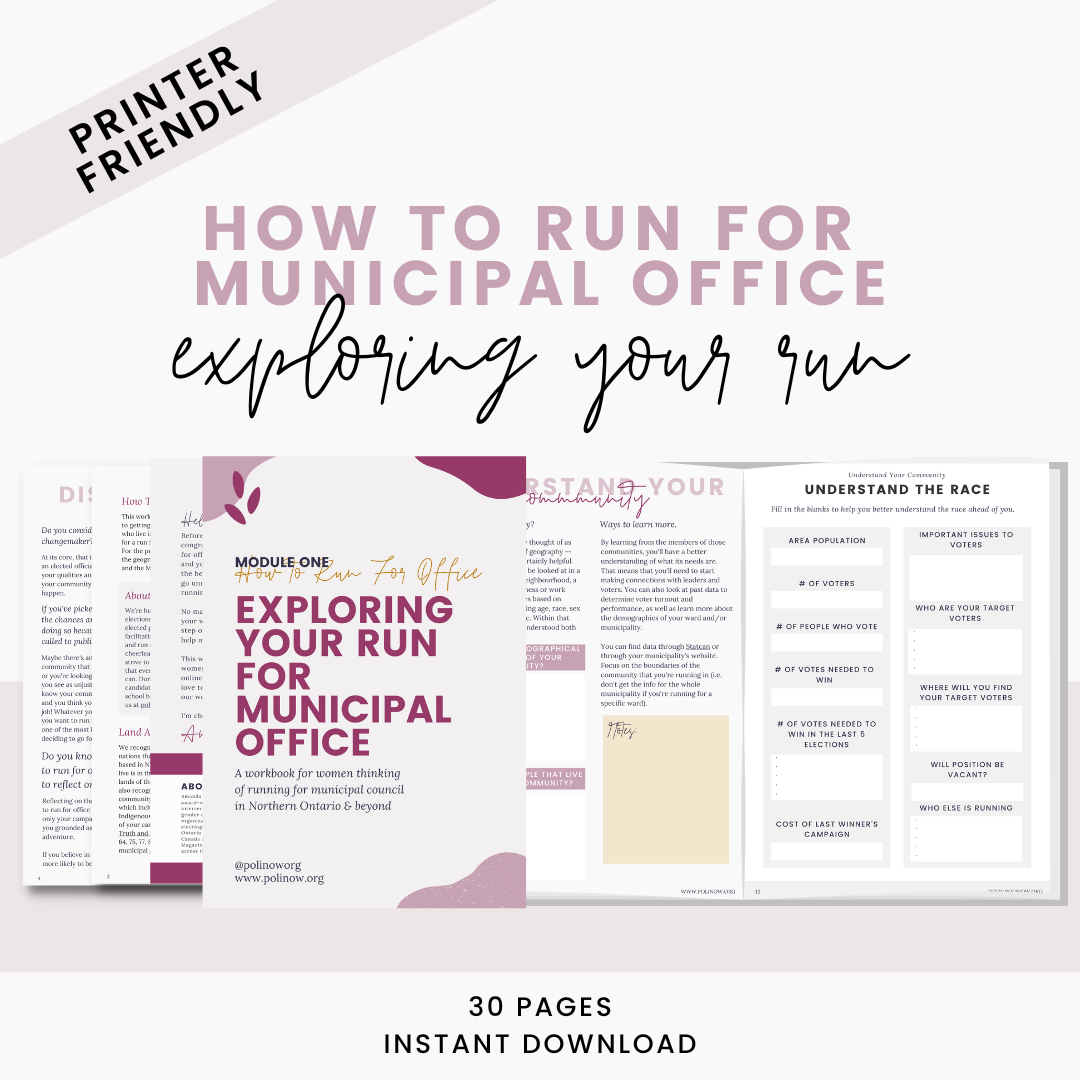
Everything you need to explore your run, make confident decisions, and prepare for a successful campaign — all in one digital workbook.
Running for municipal office is exciting, meaningful, and yes — a little intimidating. That’s why I created this workbook: to help you explore the possibility, ask the right questions, and get organized before making any big commitments.
The 2026 edition is fully updated, with clearer guidance, new resources, and a brand-new chapter on protecting your peace — because running for office is serious work, and you deserve to feel good doing it.
What’s Inside:
Updated Guidance: Refreshed examples, links, and resources relevant to 2026.
New Chapter: Protecting your peace, including a worksheet to help you set healthy boundaries.
Bonus Audio: A reworked workshop in audio format, perfect for listening on the go.
Clear Explanations: Simplified, step-by-step guidance to take the guesswork out of early campaign decisions.
Practical Worksheets: Define your mission, map your community, and build your campaign team.
Why This Workbook Works:
Helps you make a confident decision to run
Breaks down complex campaign steps into simple, actionable exercises
Created by Amanda Kingsley Malo — educator, campaign veteran, and your personal guide through local politics
Format:
30+-page PDF
Instant download
Works on computer, tablet, or phone

Are you exploring a run for office and want to understand the community you hope to serve?
This Workbook Module helps you map your community, identify key issues, and uncover where you can have the biggest impact. With exercises and reflections, it gives you the clarity and focus you need to take actionable steps toward a municipal council campaign.
In this module, you’ll explore:
Who makes up your community and what matters to them
The issues you can focus on as a candidate
How to prioritize your efforts and take meaningful action
Why grab just this module?
Sometimes you don’t need the full workbook — you just want to dive into understanding your community. This standalone chapter gives you everything from this chapter in one place, so you can reflect, strategize, and plan your next moves without flipping through the rest of the workbook.
This module is the second chapter of the HOW TO RUN FOR OFFICE: EXPLORING YOUR RUN workbook.