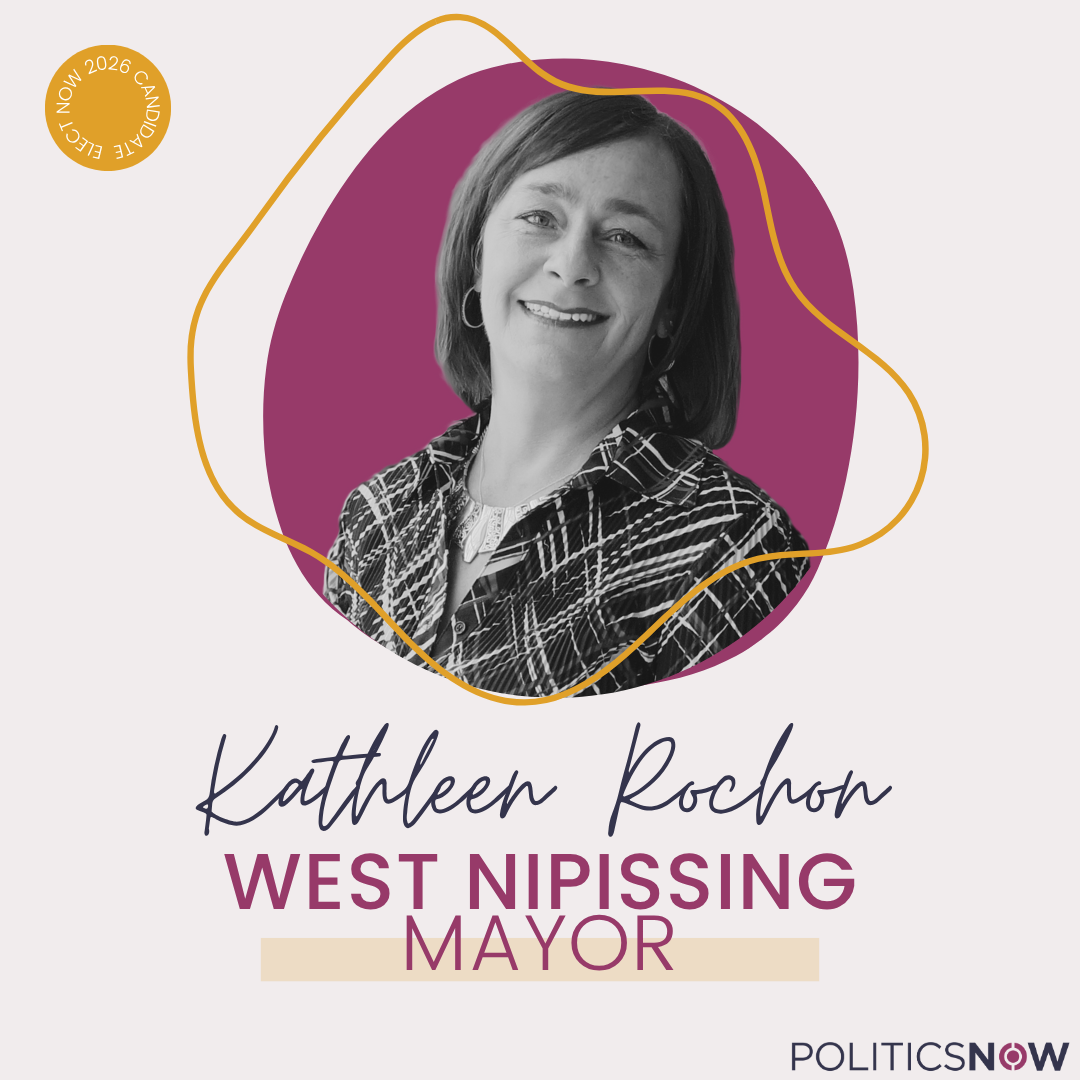
Kathleen Rochon
Kathleen Rochon is running for Mayor of West Nipissing.
Kathleen Rochon (she/her) has called West Nipissing home for nearly 20 years and currently serves as Mayor of the Municipality of West Nipissing. Before becoming mayor, she worked in economic and community development and ran her own graphic design agency. Her community involvement has included serving as president of the Chamber of Commerce and on the Municipal Economic Development Advisory Committee, as well as working with organizations including Friends of Mashkinonje Park and Sturgeon River House Museum. As mayor, she has focused on strengthening municipal leadership, building relationships with community partners, and moving forward long-needed infrastructure and community projects. She is passionate about creating opportunities for young people, supporting businesses and community organizations, and making West Nipissing a community where people can build a full and rewarding life.
Why are you running for this position?
I’m running because I truly love this community, and I genuinely love the work.
I’m driven by the opportunity to make a difference — whether that’s tackling big issues like the Verner water system upgrades and the Champlain Bridge, being actively involved in community-building initiatives like Planet Youth, or finally getting Goulard Park started after years of talking about it. I love being able to work with Council, staff, residents, and community partners to take an idea and turn it into something that actually makes a difference in people’s everyday lives.
For me, it’s not always about the big things. Sometimes it’s finding a solution to a problem someone has brought forward, helping get a community project off the ground, or making a decision that will benefit our community years down the road.
I’m passionate about West Nipissing and the people who live here. I still wake up excited about the work and the opportunity to make our community a little better every day.
After four years, I still feel like there’s so much more we can accomplish — and I’m not ready to stop.
What do you think is the biggest challenge facing your municipality right now?
I think one of the biggest challenges facing West Nipissing is simply the amount we’re responsible for compared to the size of our population. We’re a large municipality geographically, with about 14,500 people spread across almost 2,000 sq. km. Because of amalgamation, we inherited a tremendous amount of infrastructure — seven landfills, eight fire stations, multiple arenas and community facilities, hundreds of kilometres of roads, bridges, and water systems. All of it needs to be maintained, repaired, and eventually replaced, whether 100 people use it or 1,000.
And then there’s the social side of what we’re dealing with. Housing, healthcare, mental health, addictions, youth well-being — these are issues our residents are living with every day, and they absolutely affect our community. But many of them aren’t things the municipality has direct control over. We can help, bring people together, support organizations, and advocate to other levels of government, but we can’t fix everything ourselves.
That can be frustrating, because when someone comes to you with a problem, you want to be able to fix it. Sometimes we can. Sometimes we can help find a path forward. And sometimes the honest answer is no, or not yet.
I think that’s one of the harder parts of the job. Making those choices and trying to balance what people need and want with what we can realistically afford and deliver. There are always more good ideas than there are dollars and staff capacity.
If elected, what is one thing you would like to accomplish during your term?
If I had to choose one thing, it would be seeing the redevelopment of Au Château move from planning to reality.
This one is particularly important to me. Au Château is home to more than 160 residents, and like many people in our community, I want to see them have a modern, comfortable place to call home. My own mother is a resident there, so this isn’t just another project on a list for me. I see firsthand why it matters.
There’s a lot that has to happen to get a project of this size across the finish line, and not all of it is within the municipality’s control. But I want to continue doing everything we can to support the project, work with our partners, and advocate to the provincial government.
For me, success would be seeing construction underway and knowing that we’ve helped get this project to the point where a new Au Château will be there for our community for many years to come.
What is one thing you would like to see your municipality do differently?
One thing I’d like to see us do differently is continue modernizing how the municipality operates — our systems, our processes, and the way we communicate with residents.
We’ve made some progress in this area, but there’s still a lot of room to make it easier for people to interact with the municipality and easier for staff to do their jobs. Not everything needs to involve a phone call, an email, or someone having to figure out who to contact. Where we can make things simpler, more accessible, and more efficient, I think we should.
I’d also like us to be more proactive with communication. Too often, people hear about something when there’s already a problem, a decision has been made, or they happen to come across it somewhere. We can do a better job of explaining what’s happening, what’s coming up, why we’re doing something, and what residents need to know.
Some of that is technology, but it’s also about looking at our processes and asking, “Is there a better way to do this?”
We’re a small municipality with a lot of responsibilities, so finding ways to work more efficiently isn’t just about convenience. It allows our staff to spend more time on the work that actually needs their attention and helps us provide better service to residents.
How do you approach working with people who disagree with you?
One thing I’ve learned over the past four years is that I don’t have to be the smartest person in the room, and I certainly don’t have to be right all the time. I’ve always said that nine brains are better than one, and I really believe that.
I don’t expect the other eight members of Council to always agree with me... honestly, I wouldn’t want them to. I think some of our best conversations happen when people challenge each other and bring different perspectives to the table.
I try to listen, understand where people are coming from, and be willing to change my mind when someone makes a good point. But sometimes, after all the discussion, you still disagree. That’s okay too.
I think one of the most important parts of being mayor is understanding that the decision belongs to Council, not to the mayor. Once a democratic decision has been made, even if it isn’t the decision I would have made personally, I believe it’s my responsibility to accept it and support the decision of Council.
We can disagree, have a good debate, and still respect each other when the meeting is over. To me, that’s democracy... and it’s also how you build a Council that can actually get things done for the community.
What does having more women in local leadership change?
I think having more women in local leadership changes the conversation because it brings different perspectives and lived experiences into the room.
Women don’t all think alike, just as men don’t, but women can experience their communities differently. At the municipal level, the decisions we make every day — about housing, childcare, transportation, recreation, community safety, infrastructure, and economic development — can have a very real impact on women’s lives and their ability to participate fully in the workforce and the local economy.
For example, if childcare isn’t available, housing isn’t affordable, or transportation and services aren’t accessible, those barriers can make it harder for women to work, start a business, or pursue a career. These are economic issues, but they’re also municipal issues. Having women at the table helps ensure we’re considering those connections when we set priorities, make investments, and plan for the future of our communities.
And representation matters. When young women and girls see women serving as mayors, councillors, and community leaders, it helps them see leadership as something they can do too.
What is something about you that you would like voters to know that they might not learn from your campaign platform?
Something voters might not know about me is that I’m actually quite an introvert. I’m in my brain a lot — at any given time, I probably have about 62 different things dancing around in my head. I love the thinking part of this job: the research, the problem-solving, making connections, figuring things out, and then actually getting things done.
The public-facing side doesn’t come quite as naturally to me. Being in a crowd, speaking in front of people, making remarks, or being the centre of attention can make me nervous and, if I’m being honest, a little awkward. It takes some effort for me to put myself out there, and I still get butterflies before I speak in front of a room.
I’ve learned to do it because being mayor means being there... for the community, for the events, for the conversations, and at the microphone. But I don’t particularly enjoy the spotlight. I’m much more comfortable doing the work behind the scenes and letting the results speak for themselves.
I think that’s probably something people might not expect about me. I may look comfortable up there, but it’s something that I’ve had to work hard to conquer.
Where can people find you?
Facebook: https://www.facebook.com/MayorRochon
LinkedIn: https://www.linkedin.com/in/kthornerochon/
Website: rochon4mayor.com | votezrochon.com