Your Custom Text Here
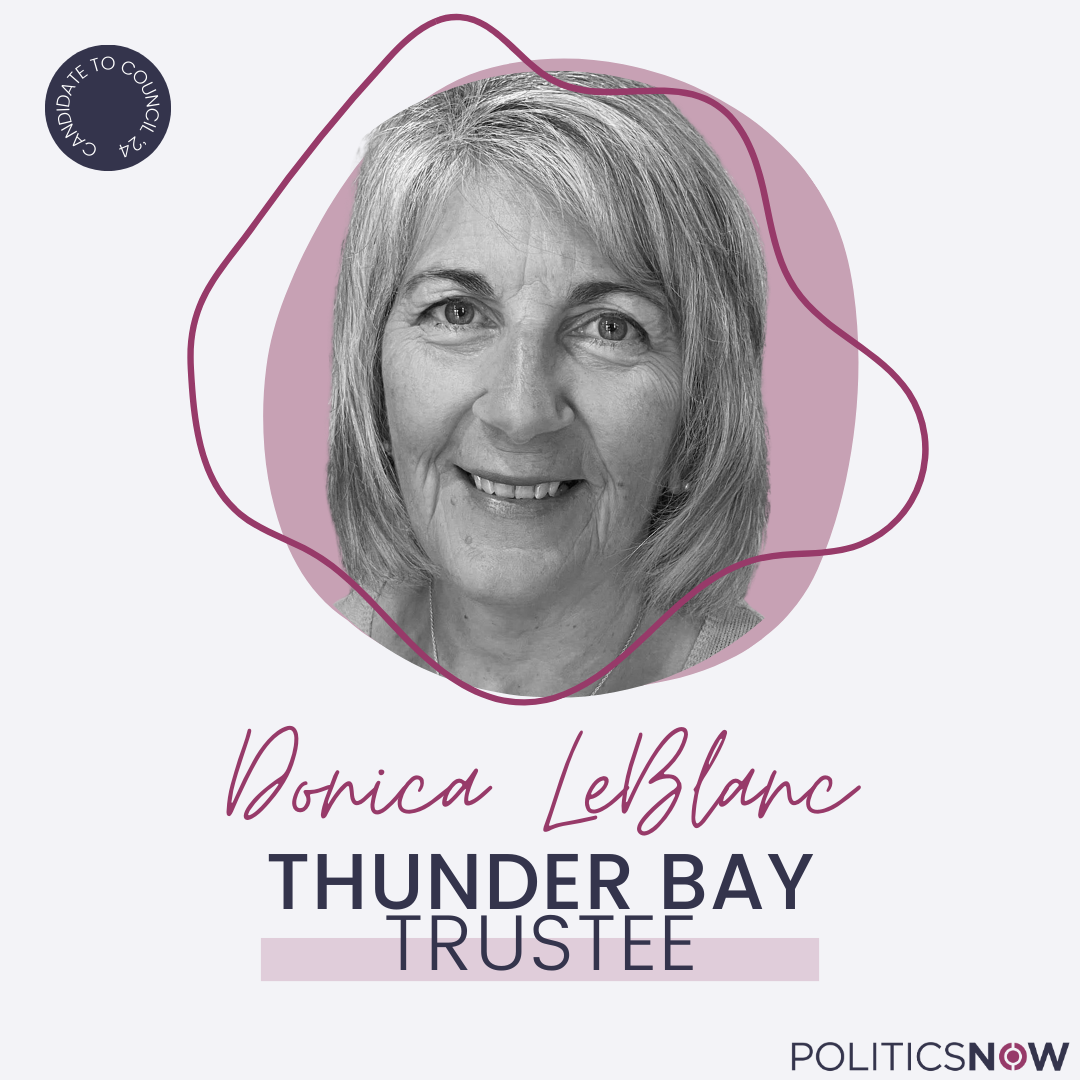
Donica LeBlanc
Donica LeBlanc is a School Board Trustee for the Lakehead District School Board in Thunder Bay.
In our ongoing effort to spotlight the experiences of women in municipal politics, we reached out to those elected in the 2022 municipal elections in Northern Ontario. We asked these newly elected councillors and trustees to share their insights and reflections on the transition from candidate to council. Here are their candid and firsthand accounts of the challenges, surprises, and lessons learned along the way.
Donica LeBlanc is a School Board Trustee for the Lakehead District School Board in Thunder Bay.
What initially inspired or motivated you to run for council, and how did you envision your role before being elected?
As a retired educator, education remains a passion as it is the most important way to improve lives. I wanted to become a trustee to see things from another perspective and be a voice for the community.
How did your expectations or perceptions change once you took office?
Not a lot. [It] was a learning curve in relation to understanding the role of the trustee and the politics of running meetings and how each meeting has a specific purpose. My role continuously reminds me I am here for the children.
Were there any surprises or unexpected aspects of the role?
I love being invited to events and the schools. I learn so much and appreciate the hard work of staff to make life better for students. The trustee relationships surprised me. A great group of people!
What were the biggest challenges you faced when transitioning from a candidate to an elected official?
Learning the role. Completing the online training was onerous. Wading through the material, building relationships with the trustees (some have been there a while, others were new), and then running for Vice-Chair!
What do you wish people knew about running for office, based on your own experience?
Running for office — [be] in the public eye, listen to people, [and] make people aware of what a trustee does. There is some paperwork and accounting, but it is not difficult when running for a trustee position.
What were the significant milestones or accomplishments you achieved during your tenure?
Learning the role, building relationships with great people, [and] being part of OPSBA and its fantastic PD.
On the flip side, what were the challenges you faced during your first year, and how did you navigate or address them?
Some challenging issues or situations to resolve. Getting through the training and then trying to implement it.
Were there specific instances or experiences that significantly impacted your approach to governance or leadership?
Marion Thompson's training on Governance and the Good Governance Guide were crucial in learning about the role. Learning to run a proper meeting and being part of committees.
What valuable lessons have you learned or insights gained that you'd like to share with others considering a similar path in politics?
Be fair, have an open mind, and be prepared to work with people who may have very opposing opinions to your own. Learn to navigate that while simultaneously being a collective voice.
What do you wish people knew about working as a politician, based on your experience?
You have to be a people person; you have to be comfortable with conflict, and sometimes work [with] the people to make things happen.
Where can people find you?
These profiles are part of our ongoing series featuring women councillors and trustees elected through the ElectNOW initiative. Surveys were sent to all woman councillors and trustees who participated in the 2022 ElectNOW series. While some answers have been edited for clarity and spelling, the responses provided are the candidates' own and do not necessarily reflect the views of PoliticsNOW. If you are a woman councillor, mayor, or trustee residing in Northern Ontario and would like to be featured in this series, please fill out our survey.
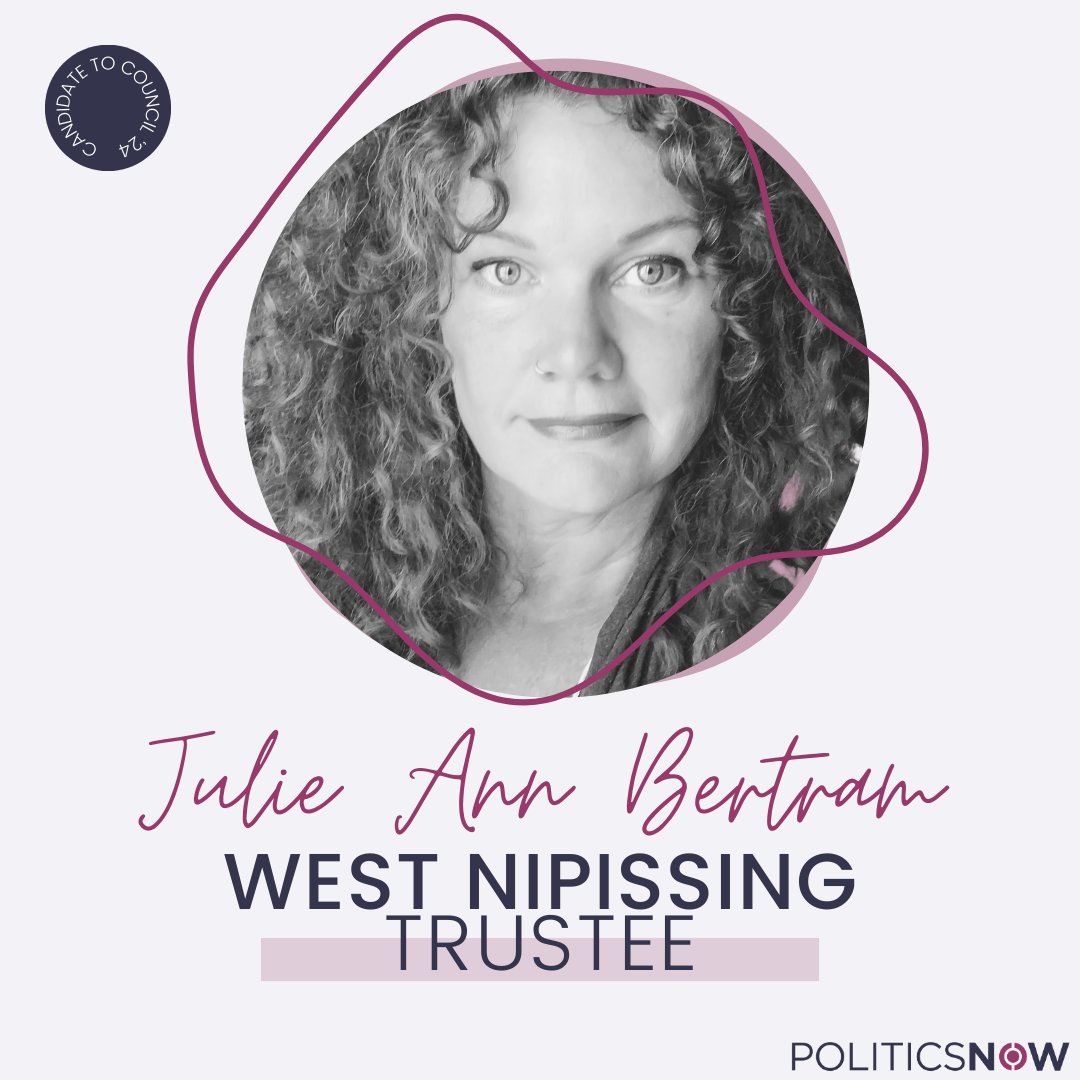
Julie Ann Bertram
Julie Ann Bertram is a School Board Trustee in Zone 1 for the Near North District School Board in West Nipissing.

In our ongoing effort to spotlight the experiences of women in municipal politics, we reached out to those elected in the 2022 municipal elections in Northern Ontario. We asked these newly elected councillors and trustees to share their insights and reflections on the transition from candidate to council. Here are their candid and firsthand accounts of the challenges, surprises, and lessons learned along the way.
Julie Ann Bertram is a School Board Trustee in Zone 1 for the Near North District School Board in West Nipissing.
What initially inspired or motivated you to run for council, and how did you envision your role before being elected?
I was inspired to help my community by actively participating, and promoting the role of public education as a means to improve society. I expected a large learning curve, which is still happening. I also expected to be able to share ideas easily with colleagues.
How did your expectations or perceptions change once you took office?
The abundance of red tape is ridiculous… e.g. Robert’s Rules [being] used as a hindrance to dialogue instead of a guiding template for meetings. There seem to be plenty of egos and personal agendas going around.
What do you wish people knew about running for office, based on your own experience?
People should understand that a board’s policies, bylaws, and guidelines are fundamental to governance. I wish I had spent more time familiarizing myself with them while running for election - it would have saved me months of stress, jumping into the role and frantically trying to absorb so much information while also dealing with decisions/processes that were already in place before I arrived.
Looking back at your first year in office, what were the most rewarding aspects of serving in your municipal role?
I found out that I love conferences, everyone is there for a common purpose. Conversations with people who genuinely care about making the world a better place [are] so inspiring! Bringing that enthusiasm back has been incredibly rewarding, and has helped improve my ability in the role.
On the other hand, what challenges did you face during your first year, and how did you navigate or address them?
I learned how to be bold! There is no [room] for being timid. I feel a lack of communication, and it’s difficult to navigate, but emotions should not overwhelm the reasons I’m there in the first place. Calming my anxiety has been a great skill to learn!
What valuable lessons have you learned or insights gained that you'd like to share with others considering a similar path in politics?
This is something that people should understand: diplomacy is key to building and sustaining relationships, [whether] with colleagues or with the public. Thick skin and strong ethics are required.
Where can people find you?
In our ongoing effort to spotlight the experiences of women in municipal politics, we reached out to those elected in the 2022 municipal elections in Northern Ontario. We asked these newly elected councillors and trustees to share their insights and reflections on the transition from candidate to council. Here are their candid and firsthand accounts of the challenges, surprises, and lessons learned along the way.
Kathy Hamer is a councillor in McDougall.
WERE THERE ANY SURPRISES OR UNEXPECTED ASPECTS ABOUT THE ROLE?
I was surprised by the learning curve associated with becoming an elected official. I thought I had experience from working on non-profit boards previously, serving in various roles on these boards and on different types of boards. While the gist of how a meeting is supposed to occur and how governance works are transferable skills, they did not prepare me for the formalities of council proceedings, the distinctions between resolutions and bylaws (which may seem trivial now), etc. I also found it difficult to locate the necessary resources to guide me on simple procedures.
WHAT WERE THE BIGGEST CHALLENGES YOU FACED WHEN TRANSITIONING FROM A CANDIDATE TO AN ELECTED OFFICIAL?
I found a few great resources when I decided to run for council - a certain Amanda Kingsley for PoliNow was an amazing resource; ElectHer, government resources online which provided much-needed guidance on running a successful campaign. Once I became an elected official, the resources seemed to dry up. Yes, there is training by your local council, but I felt unprepared moving forward after the training. This might be affected by how many new members are elected to the council for the term. I also found it difficult to find the same level of resources as before the election.
It was like starting a new job with very little hands-on training. The available training doesn’t seem to start with the basics — things like how to deal with a ratepayer with a complaint or concern, initiate a bylaw, or support a request for support from another municipality.
WHAT VALUABLE LESSONS HAVE YOU LEARNED OR INSIGHTS GAINED THAT YOU'D LIKE TO SHARE WITH OTHERS CONSIDERING A SIMILAR PATH IN POLITICS?
When you are first elected, you are congratulated, and everyone you speak to seems happy that you were elected. Things start to change when you don’t necessarily support a ratepayer in the way they feel you should because you are making a decision based on the good of the whole community.
I am serving on a council with a very small population. Hence, you need to mind your conversations/behaviour/appearance in public, including personal conversations. People will recognize you, but you may not recognize all your ratepayers, or realize other community members are aware of who you are.
Ratepayers will also contact you with a concern/problem and expect you to fix it. This can cause problems with staff as they try to follow procedures and policies that you may be unwittingly not following. It is best to redirect the issue to the correct staff member and allow them to address it.
WHAT DO YOU WISH PEOPLE KNEW ABOUT WORKING AS A POLITICIAN, BASED ON YOUR EXPERIENCE?
I am learning that while I like to explain things, it is not necessarily the best thing to do. You may try to explain why a decision was made, and something you innocently said while trying to explain can be taken out of context and shared with other community members.
I think the biggest misconception is that as a politician, you have more control over staff than what you really do. We serve in a governance position, and as such, we provide the overall guidance/direction of how the community will run, but we do not get involved in the day-to-day operations.
CONTACT INFORMATION
Email: khamer30@gmail.com
These profiles are part of our ongoing series featuring women councillors and trustees elected through the ElectNOW initiative. Surveys were sent to all woman councillors and trustees who participated in the 2022 ElectNOW series. While some answers have been edited for clarity and spelling, the responses provided are the candidates' own and do not necessarily reflect the views of PoliticsNOW. If you are a woman councillor, mayor, or trustee residing in Northern Ontario and would like to be featured in this series, please fill out our survey.
Judy Kosmerly
Judy Kosmerly is a School Board Trustee in Area 3, Wards 5 & 6 for Rainbow District School Board in Greater Sudbury.

In our ongoing effort to spotlight the experiences of women in municipal politics, we reached out to those elected in the 2022 municipal elections in Northern Ontario. We asked these newly elected councillors and trustees to share their insights and reflections on the transition from candidate to council. Here are their candid and firsthand accounts of the challenges, surprises, and lessons learned along the way.
Judy Kosmerly is a School Board Trustee in Area 3, Wards 5 & 6 for Rainbow District School Board in Greater Sudbury.
What initially inspired or motivated you to run for council, and how did you envision your role before being elected?
I believed that my 34.5 years of employment with the Provincial Government had given me the knowledge and skills needed to be a school board trustee, plus I was very interested in learning more about the Education sector in general. I believed my role as a trustee would be one of governance.
How did your expectations or perceptions change once you took office?
My expectations didn't really change—a trustee's role is essentially one of governance and oversight, especially at the board table. What I didn't expect was how much I enjoyed the more social component of the trustee role—visiting schools, meeting students, attending graduation ceremonies and board-wide (and school) special events such as the Challenge Meet, science fairs, heritage fairs, pow wows, Fun Fairs, etc. This is my favourite part of the trustee's role.
What were the biggest challenges you faced when transitioning from a candidate to an elected official?
Understanding the acronyms used by the school board and others in the education sector.
What do you wish people knew about running for office, based on your own experience?
Do your research and know what the role of a trustee is before putting your name in to run as a trustee. I couldn't believe how many people I spoke to don't know what a trustee does, and how many think our role is the same as that of a city councillor or of a politician from a political party. It isn't!
Looking back at your first year in office, what were the most rewarding aspects of serving in your municipal role?
For the term that started in October 2022: being able to attend events, such as graduations and special events, in person rather than virtually.
What valuable lessons have you learned or insights gained that you'd like to share with others considering a similar path in politics?
Be a team player, be open to new ideas, and keep your focus on student success and well-being. Trustees do not have individual authority—they are expected to work together to make decisions that support [the] success and well-being [of] all students.
What do you wish people knew about working as a politician, based on your experience?
Again, understand what the role of a trustee is. The role of a trustee is a very important one— it is critical to know what your role is before you throw your hat into the ring.
Where can people find you?
These profiles are part of our ongoing series featuring women councillors and trustees elected through the ElectNOW initiative. Surveys were sent to all woman councillors and trustees who participated in the 2022 ElectNOW series. While some answers have been edited for clarity and spelling, the responses provided are the candidates' own and do not necessarily reflect the views of PoliticsNOW. If you are a woman councillor, mayor, or trustee residing in Northern Ontario and would like to be featured in this series, please fill out our survey.
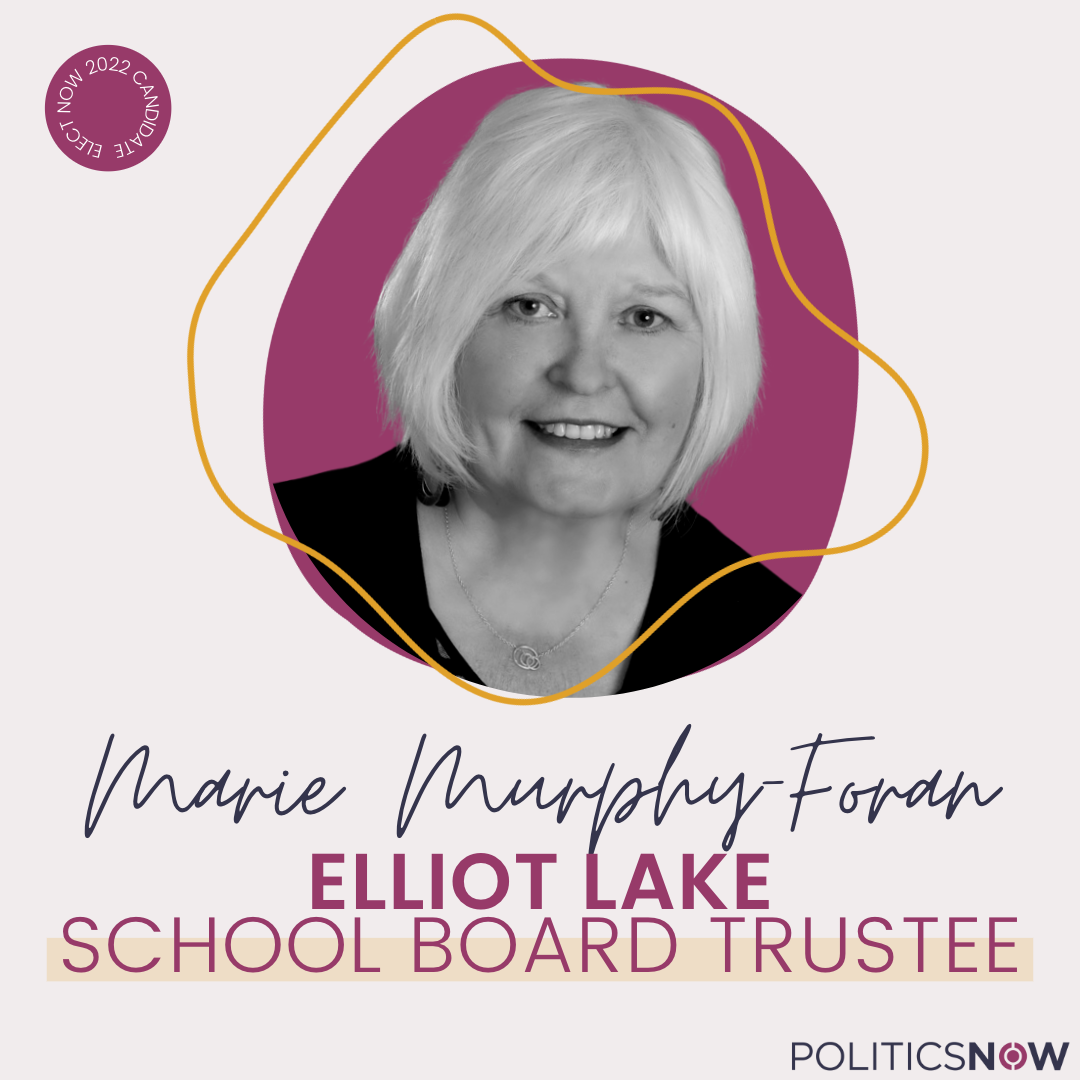
Marie Murphy-Foran
Marie (she/her) was first elected and began her journey as a trustee in 2018. Her background and experience in community leadership and engagement lend themselves to an understanding of the importance of advocacy and governance. The past four years have provided her with a better understanding of the framework in education at the local, district and provincial levels.
Marie Murphy-Foran is running for School Board Trustee for the Algoma District School Board in Elliot Lake.
Marie (she/her) was first elected and began her journey as a trustee in 2018. Her background and experience in community leadership and engagement lend themselves to an understanding of the importance of advocacy and governance. The past four years have provided her with a better understanding of the framework in education at the local, district and provincial levels.
Why are you running for this position?
My passion for education results from seeing the complexities and challenges of the education system as a mother, spouse, coach, professor, and trustee. My two children graduated from Elliot Lake Secondary School, and through their high school career and beyond, I was an active member of the athletic community, having coached basketball for ten years. I continued to expand my love of Elliot Lake Secondary School by teaching the Duel Credit Tourism and Hospitality as a professor at Sault College.
I firmly believe that our future is dependent on all students gaining the necessary skills, knowledge, attitudes and values to succeed in a global market. Algoma District School Board has a student success framework based on student-centred learning, achievement, engagement and wellness. A philosophy we keep in the forefront is, “Education is not just about delivering diplomas. It’s about delivering better lives…better futures”.
What innovative projects would enhance life in your municipality?
The community of Elliot Lake would benefit from a broader understanding of inter-generational programs. There is a remarkable resource of retirees that have moved to our community with expertise, skills and abilities that could complement school programs.
Over time, we have unfortunately segregated retirees from other populations in the community. The opportunity would see a garden program at each school, partnering with the horticultural society or community seniors.
If you received a $1 million grant to use for your municipality any way you wanted, what would you do with it?
If I received a million dollars, I would use it to kick start a Community Foundation whose purpose would be to work with schools, not for profits to identify and fund community-based programs. This foundation would be based on shared costs and sweat equity of participants.
What do you think are the greatest challenges your municipality faces?
Forward-thinking.
Other than the official ways of communicating (minutes, municipal notes), how else will you reach out to your constituents to involve them in the decision making process?
I attend functions such as graduations and coop luncheons with students and businesses. I attend school meetings and scholarship banquets and represent the board on the Parent Involvement committee.
The past two years have allowed Educators opportunities to build relationships with parents and families, and Boards have been reminded of the vital role of parents, families and community in our schools.
The Parent Involvement Committee and school councils can and should provide an opportunity for engaging parents, families and the community at the board and school levels. My energies will be focused on working with the parents, families, schools and board representatives to ensure we have a framework for conversation, learning and support that allows all of us to make decisions regarding equity, inclusion and student-centred education. The Parent Involvement Committee is the conduit for parents, families and the community to support the board initiatives and become knowledgeable about programs, policies and directions or challenges facing the board. Algoma District School Board can now host virtual meetings, bringing outlying areas for seminars, symposiums or presentations into a virtual meeting space.
As to school councils, the more we share what is happening board-wide will open the lens to our program opportunities in the outlying districts. When we talk about programming in technology, robotics, coding, outdoor education and other special programs such as high skills majors in healthcare, tourism/hospitality, construction trades etc, it would be beneficial to make the community aware. Our board offers numerous co-op options to meet some of their workforce needs. The school council is a conduit for establishing a sense of belonging for all students and parents. It can also be the conduit for tough discussions about equity, inclusion, diversity, achievement and well-being.
What is your favourite thing to do in your municipality?
The outdoors for summer fishing and ice-fishing.
Why do you think it’s important for women to be represented in civic leadership, including on committees, boards and municipal councils?
Until we no longer have policies that discriminate against women or any diverse group, we need to have women and diverse groups as fair representatives in a community,
What does a ‘feminist city’ mean to you?
A feminist city means a community that recognizes principles of equality but takes it one step further to equity. My favourite saying is, “Yes, we give everybody a pair of shoes, fair and equal, but equity ensures the shoes fit.”
In a community, we have so many diverse needs. One size does not fit all.
Please identify the most critical policy, project, or initiative in your platform that addresses systemic barriers faced by women in your municipality, and describe why:
My goal is to enhance involvement in the Parent Involvement committee and the School Councils as a conduit for local citizens to participate in a positive role, learn in a leadership role, run meetings and share information etc., all leading to a positive impact for students in the schools.
The school councils should welcome any diverse group as an avenue for participation, learning and giving feedback.
The school council could give a great experience for someone wanting to be a trustee in the future.
Where can people find you?
Facebook
Email
http://ontarioschootrustees.org
Learn about the other women running in the 2022 Ontario Municipal Election in Northern Ontario.
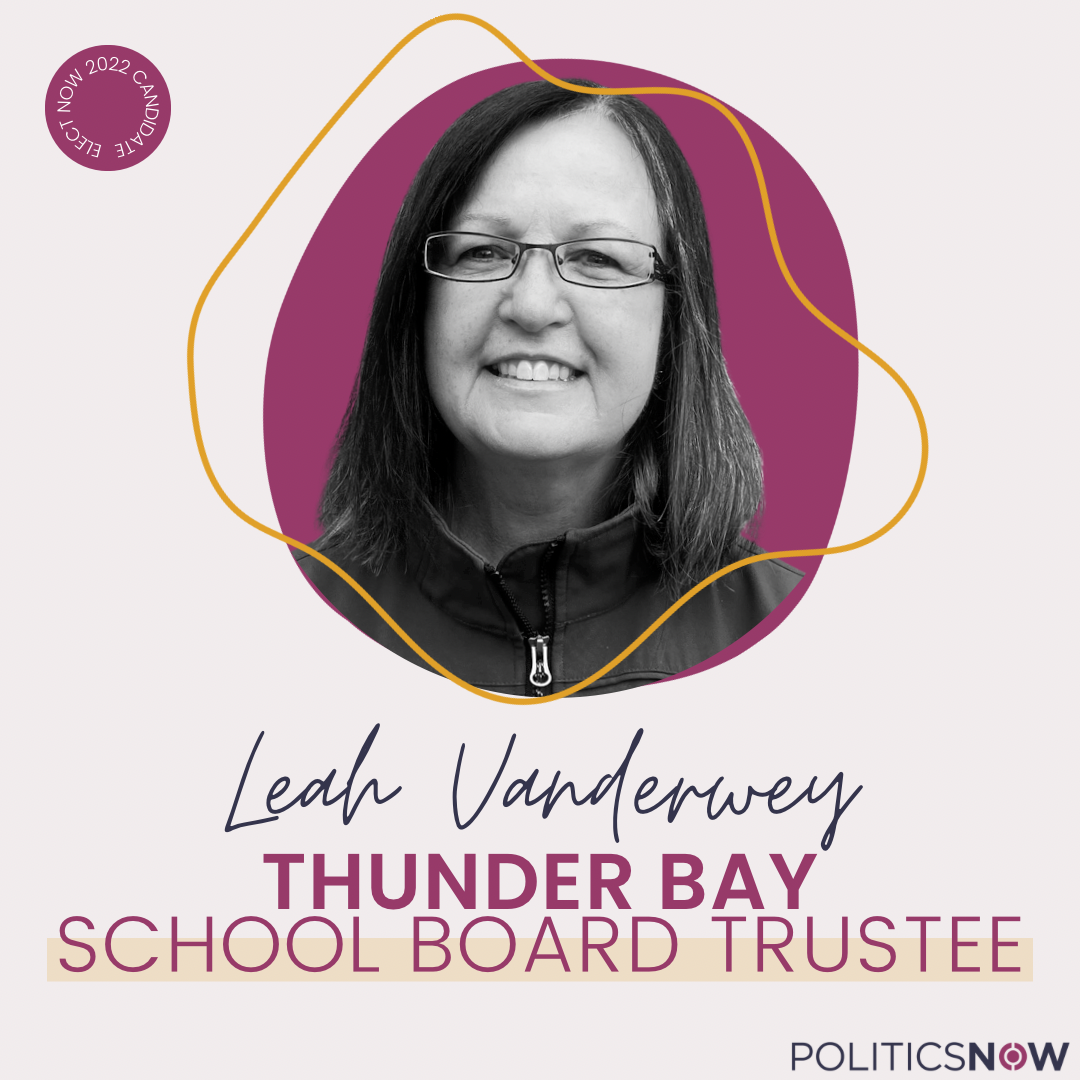
Leah Vanderwey
Leah (she/her) retired two years ago after 33 years in education. She has worked for Lakehead Public Schools, three regional school boards, and the Ministry of Education in various roles, including teacher, principal, superintendent, Student Achievement Officer, and Thunder Bay regional manager for Field Services. Many of these roles allowed her to work with different staff and students across Northwestern Ontario. Those work opportunities provided Leah with not only a local perspective but a regional and provincial one. As a Trustee, she believes she can bring that breadth of knowledge as the elected board of trustees participates in making decisions that would benefit all schools and their communities. She remains committed to quality education and would love the opportunity to be a voice of education experience for the community at the trustee table.
Leah Vanderwey is running for School Board Trustee for the Lakehead Public School Board in Thunder Bay.
Leah (she/her) retired two years ago after 33 years in education. She has worked for Lakehead Public Schools, three regional school boards, and the Ministry of Education in various roles, including teacher, principal, superintendent, Student Achievement Officer, and Thunder Bay regional manager for Field Services. Many of these roles allowed her to work with different staff and students across Northwestern Ontario. Those work opportunities provided Leah with not only a local perspective but a regional and provincial one. As a Trustee, she believes she can bring that breadth of knowledge as the elected board of trustees participates in making decisions that would benefit all schools and their communities. She remains committed to quality education and would love the opportunity to be a voice of education experience for the community at the trustee table.
Why are you running for this position?
Lakehead Public Schools is a system that faces many of the challenges of Northwestern Ontario: isolated schools, rural schools, and urban schools. I am running for this position to help bring the different communities' voices to the trustee table.
What do you think are the greatest challenges your municipality faces?
After listening to the session, Deconstructing the Reconciliation Conversation, I was struck by a question the speaker asked about Every Child Matters. The question was, "What matters to every child?" Perhaps to start to answer the question, we might look at a partnership with the city and schools to collect voices from children and their parents/guardians to determine what matters to every child in our municipality.
If you received a $1 million grant to use for your municipality any way you wanted, what would you do with it?
I would apply it to the project above so that the needs of our children are being identified and met within the community.
What do you think are the greatest challenges your municipality faces?
The greatest challenges that our municipality faces are drug addiction, gangs, and violence.
Other than the official ways of communicating (minutes, municipal notes), how else will you reach out to your constituents to involve them in the decision making process?
Social media. Opportunities to meet with parent groups or holding town hall meetings.
What is your favourite thing to do in your municipality?
I love to curl, play ball, and walk the various walking trails in Thunder Bay and the surrounding areas.
Why do you think it’s important for women to be represented in civic leadership, including on committees, boards and municipal councils?
I think it is important for women to be represented so that we are role models to others that we provide value added leadership to committees, boards, and municipal councils.
What does a ‘feminist city’ mean to you?
A "feminist city" means women are equally represented and respected for their work.
Please identify the most critical policy, project, or initiative in your platform that addresses systemic barriers faced by women in your municipality, and describe why:
In education, the systemic barriers faced by women might begin in childhood. For example, are there any courses in secondary school that are largely male-dominated? If yes, this would provide an opportunity for staff to determine why that might be the case.
Where can people find you?
Learn about the other women running in the 2022 Ontario Municipal Election in Northern Ontario.
Julie Ann Bertram
Julie Ann (she/her) is a parent of 3 children attending schools within the NNDSB. Her background is in the arts, as a musician and writer. She has been running a business in West Nipissing for over ten years and sits on a few volunteer committees in her small community of Field. She believes that strong and progressive communities begin with a strong and progressive public education system.
Julie Ann Bertram is running for School Board Trustee in Zone 1 for the Near North District School Board in West Nipissing.
Julie Ann (she/her) is a parent of 3 children attending schools within the NNDSB. Her background is in the arts, as a musician and writer. She has been running a business in West Nipissing for over ten years and sits on a few volunteer committees in her small community of Field. She believes that strong and progressive communities begin with a strong and progressive public education system.
Why are you running for this position?
I can bring a different type of insight and expression to the table where the voices of our students, parents, teachers, and support staff are heard while upholding the progressing vision, mission, and values of the Board and the Ministry of Education. Concise communication between advocates, the Board, and policymakers is key to quickening action taken throughout the public education system.
With the pandemic came extra responsibilities at home, I became involved in my children’s schooling much more than I had ever planned. During this time, it was important for me to understand how they learned, what they missed about in-class learning, how they navigated online learning, and what they liked about learning from home. Now that most students are back in the classroom, I feel it urgent that extra academic assistance and mental/social health supports are available within schools to help alleviate the stress of the past few years. These observations, along with further discussions, can be beneficial to creating a future of education where our children are inspired, engaged, and well-prepared for the next stages of life in society.
What do you think are the greatest challenges your municipality faces?
The challenges our municipality faces are the same as most: a high cost of living, reduced quality of life, food insecurity, homelessness, problematic substance use, violence, and a rise in mental health issues combined with a lacking support system.
Other than the official ways of communicating (minutes, municipal notes), how else will you reach out to your constituents to involve them in the decision making process?
It is important to note how most people prefer to communicate these days.
Social media campaigns and direct emails with concise messaging, perhaps witty, and inventive correspondence from trustees to the community can surpass the traditional humdrum notices we all tend to ignore, and therefore tend to miss out on pertinent information. I feel a lack of humour in general has been a detriment to what should be an overall excitement as we help shape the future! We may want to take a step forward, away from the conventional solemnity that has been the norm.
Involving students in these communications is also important. Young people have generous and infectious energy that will automatically bring parents and community partners into the information fold.
Why do you think it’s important for women to be represented in civic leadership, including on committees, boards and municipal councils?
Women in leadership positions bring a less authoritative and more collaborative approach to the workplace, providing a different set of talents and imaginative solutions to the table. A creative perspective and unique sensitivity allow for ideas that may otherwise be missed.
Where can people find you?
Facebook
mail@julieannbertram.com
289-970-0150